
 From Strasbourg to Kraków:
An Interview with Nayana Lahiri and Hoa Nguyen
Highlight from the: EHDN Newsletter_March2026_Issue57
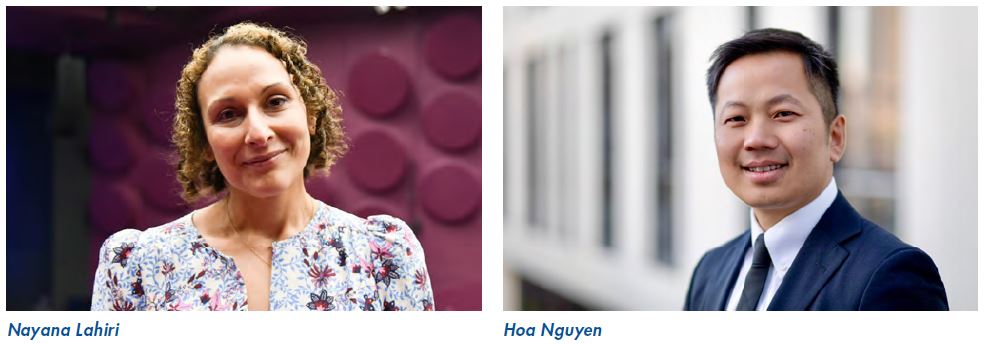
Nayana Lahiri (St George’s University Hospital, UK) and Hoa Nguyen (Ruhr University Bochum, Germany) were elected to EHDN’s Executive Committee (EC) at EHDN & Enroll-HD 2024 in Strasbourg. We caught up with them to hear about their experiences of serving on the EC and leading the EHDN Clinical Research Congress 2026 Programme Committee, and what the community can look forward to in Kraków.
What is your background?
Hoa: I’ve been involved in HD research since 1999, and since 2003, I’ve been working in clinical genetics. I’ve been at Ruhr University Bochum since 2018, where I am currently Chair of the Department of Human Genetics. We have a large HD centre where I work in diagnostics and counselling with patients while continuing work on a range of research questions, including the mechanisms underlying huntingtin degradation in HD.
Nayana: I first started working with HD families in 2007 when I joined Sarah Tabrizi’s lab at University College London to work on the TRACKHD study. After finishing my MD thesis, I returned to Clinical Genetics training and became a consultant at St George’s, where I set up a dedicated HD service. My work is largely clinical, focused on improving care for families, and I’m currently working on international updates to the predictive test recommendations.
How did you get involved with EHDN?
Hoa: I’ve been involved right from the very beginning and recall attending the first EHDN meeting just outside Madrid! Over the years, I’ve been involved in various working groups and, more recently, I’ve served on the Scientific and Bioethics Advisory Committee reviewing Seed Fund proposals. I was elected to the EC in 2024.
Nayana: My first EHDN meeting was in 2008, and like Hoa, I was initially involved in different working groups. Later, I became co-chair of the Genetic Counselling Working Group and was asked to help establish the Incidental Findings Task Force. I have remained involved in various capacities, including serving on the EC since my election in 2024.
What was your motivation for standing for election to the EC?
Hoa: EHDN has grown tremendously over the last two decades, and a lot of work goes on behind the scenes. I was really keen to learn more about EHDN’s strategy and direction, and to have the opportunity to help shape this. Being on the EC means being at the forefront of thinking about what matters to HD-affected families and the HD community, and bringing our experiences and opinions to the table collaboratively.
Nayana: Having been part of EHDN for so long, it was a huge privilege to stand for election to the EC and to have the opportunity to help shape the future of the organisation. We always say that the HD community embraces researchers, clinicians, and HD families in the shared mission of improving care and advancing HD research. I’ve gained so much from being part of this community – giving something back by being on the EC is a pleasure.
| ‘Being on the EC means being at the forefront of thinking about what matters to HD-affected families and the HD community, and bringing our experiences and opinions to the table collaboratively.’ Hoa Nguyen |
What does serving on the programme committee involve?
Nayana: Kraków was announced at EHDN & Enroll-HD 2024, and planning started immediately. It’s really exciting to embed the work of EHDN with the latest scientific and clinical advances, as well as developments from Enroll-HD. The programme committee is a relatively small group representing EHDN, CHDI, and Enroll-HD, and we have local Polish representation to support planning.
Hoa: At this stage, we have developed a preliminary programme. Some details are still in progress, but overall it looks really good. We felt it was important to use our knowledge as clinicians to determine the questions that other clinicians and people impacted by HD will want to hear about.
What can we look forward to in Kraków?
Hoa: Excitingly, Aaron Ciechanover, the Israeli biologist who shared the 2004 Nobel Prize in Chemistry, will be one of our keynote speakers. He is renowned for his work in characterising the process of protein degradation. This year’s programme will span a very broad range of topics that will hopefully interest everyone in the HD community, including the translation of research findings into the clinic.
| ‘This year’s programme will span a very broad range of topics that will hopefully interest everyone in the HD community, including the translation of research findings into the clinic.’ Hoa Nguyen |
Nayana: We also wanted to place genomics front and centre of the programme. There have been many important advances in recent years, and we’ve planned a session on how to embed some of them into clinical practice. Another session will look at how best to communicate results and outcomes from clinical trials to the community, a topic of great importance right now. As in previous years, we will also have a range of lively social and networking events, offering many opportunities for delegates to connect with the wider HD community.
| EHDN Elections 2026: Nominations for the Executive Committee (EC) and Scientific and Bioethics Advisory Committee (SBAC) will open in early Spring, followed by the election of the candidates in summer – details to follow. Results will be announced at the EHDN Clinical Research Congress in Kraków. |